Menu
Close menu

Cloudtap Q&A - How to choose your filters

Cloudtap has a lot of configuration options. Our filter quiz can build/recommend one for you, but what do all those questions actually mean?

post published 26th Nov 2025
post published Calculating...
Cloudtap Q&A - How to choose your filters

Cloudtap filtration systems are built for flexibility, with over 40 possible configurations on our whole-home units alone. That's... a lot of options. Too many to look at all at once.

We've set up some tools to streamline the selection process and help you find options that are relevant to you, but many customers also want to know why those options are relevant.

One of the best parts of filtering chemicals and contaminants out of your water is that you know exactly what's coming out of your tap - but what's actually happening under that stylish Cloudtap cover?

If online quizzes aren't your thing, these questions can help you make informed decisions about your filters and build a system that's tailored to your home and water.

Cloudtap's current filter options include:

  • 5-micron poly spun sediment filters
  • 5-micron poly pleated washable sediment filters
  • 20-micron low-pressure-drop carbon filters for taste and odour
  • Scaleblock, a dedicated softening cartridge that addresses limescale, chlorine, and heavy metals
  • 0.5-micron composite carbon for heavy metals
  • 0.5-micron catalytic carbon for chloramine (a chlorine-ammonia compound with more staying power than ordinary chlorine)
  • 0.5-micron silver-impregnated bacteriostatic filters for keeping bacteria from forming in non-chlorinated water
    (IMPORTANT: this is NOT a disinfecting filter - it will keep new bacteria from growing in the filtration system itself, but it won’t kill anything that’s already there)

Using these options, we’ve built 9 different filter packs to suit different homes and lifestyles. The quickest way to pick one is by taking our filter quiz, but if you’d like to understand why we’re asking what we’re asking, you’ve come to the right place. Read on!

Two-stage essential series system
Three-stage essential series system

Question 1: Where does your water come from?

This is the biggest factor in determining which filters will suit your home and water. Most Australian homes are connected to some kind of municipal/mains water supply, receiving water that’s been treated with chemicals like chlorine and fluoride.

However, if your home is connected to a rainwater tank, there won’t be any chemicals at all - at least, none that were deliberately added for the purpose of making it more drinkable. Bore water is different again, containing much higher levels of sediments and dissolved minerals than mains or tank water.

If you have a water meter at the front of your house or you receive a water bill from your local utility, your home is connected to mains water. This means you’ll want a spun sediment filter rather than a pleated one, and two other cartridges tailored to the water conditions in your particular area (more on that later).

If your water comes straight into your home via a bore, you should speak with a plumber or technician directly; no two bores are identical, so the perfect system for your home will vary depending on the kinds of impurities that might be in your water.

However, most bore water setups will still benefit from a spun sediment filter, often paired with a Scaleblock conditioning cartridge to deal with excessive hardness and either a composite carbon block for heavy metals or an antibacterial silver cartridge for pre-disinfection filtration.

A design series system without its cover mounted on a wall
A surf mist design series system

Question 2: What's in your water?

We don’t expect everyone to know the full chemical breakdown of every drop that comes out of your tap, but a general idea can help us tailor a system to your needs (and avoid charging you for removing impurities that were never there in the first place).

Some of the impurities we ask about are:

  • Chlorine: this one is typically answered by the first question, but it’s also one of the easiest to taste/smell. Fortunately, all our filter packs will help with chlorine!
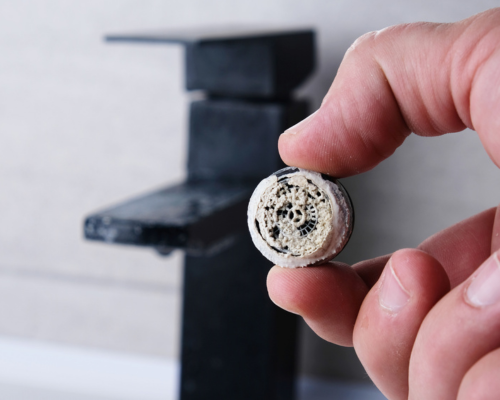
  • Limescale: if you have to deal with chalky residue staining your taps and etching your shower screen, you’ll want a filter pack designed specifically for limescale and hard water.
  • Chloramine: you might have to google this one. In some regions, chlorine is combined with ammonia to make a stronger molecule that lasts longer in mains pipes. Only catalytic carbon filters can break down this stubborn chemical.
  • Heavy metals: if you have concerns about lead, mercury, cadmium, or other metals in your water, a composite carbon filter designed for next-level heavy metal removal should probably be on your radar.
  • Bacteria: our systems aren’t designed for water that isn’t microbiologically safe, but there are plenty of safe water sources that don’t contain disinfectants like chlorine. If you don’t have chemical treatments in your water, you might want filters that prevent bacteria from forming inside your filtration system.

If your home is connected to mains water, most water utilities will have publicly available data about water quality in specific regions.

The specificity of the data will vary depending on which state you're in; South Australia has a tool that provides detailed breakdowns for your specific address, while Western Australia just lists the data in their reports. If you're not sure who your water utility is, check your water bill.

Surf mist design series system
Design series system against a grey wall

Question 3: Where will you put the filtration system?

Cloudtap's customisation goes well below the surface, but that surface is still important. Our filter packs are designed to target different water conditions, but your home and plumbing layout are also factors in determining the ideal configuration.

If you're planning on installing the filter up against a wall along a shaded part of your house, you can save some money without sacrificing filtration performance by setting up one of our Essential Series units. They're a bit more fiddly to install, as your plumber will need to supply and assemble the necessary pipes and valves themselves, but the smaller footprint (and price tag) can be very appealing.

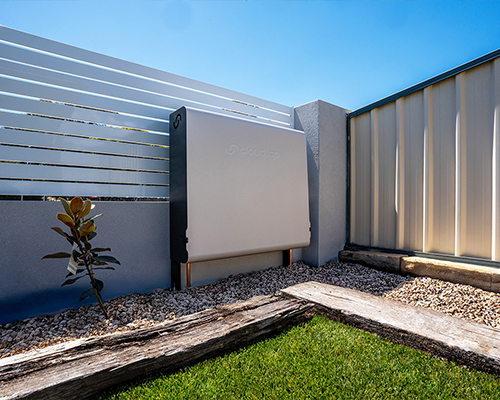
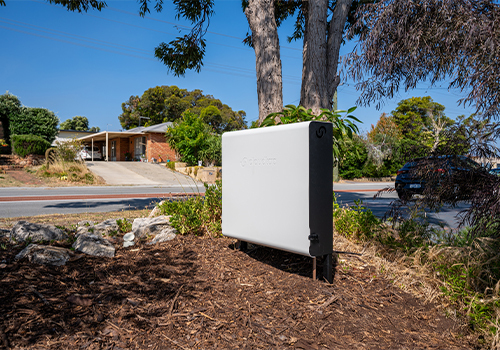
If you'd rather not drill something into your walls, our Design Series units come with metal legs that slot into the frame for easy free-standing installation. They also come fully enclosed in a UV-resistant cover, so you can place the box in full sunlight without worrying about sun or weather damage to the inner workings.

The Design Series also allows for more customisation, with multiple colour options for the protective cover. We can even do custom colours to match your home's aesthetic - one of our directors has a green one!

When in doubt, just reach out

We're always working on new resources to make these kinds of decisions easier, but the best way to address any questions or queries will always be to contact us directly. After you've filled out our filter quiz, our team will reach out to see if you have any follow-up questions and discuss installation logistics.

If you're not sure how to answer some of the quiz questions (or just want to speak to a real person instead of a pre-scripted form or chatbot), you can call us directly on 08 9202 6909 or email info@cloudtap.com.au to speak with our team. You can also message us directly on Facebook, Instagram, or LinkedIn - check the icons at the bottom of this page for our links.

Popular articles

What are DBPs?
What are DBPs?
Chemical treatments are a vital part of providing safe water for Australian households, but that doe
Read article
What is hard water?
What is hard water?
No, we're not talking about ice. Hardness is one of several invisible characteristics about your wat

Read article
Benefits of Whole-Home Filtration: Why should I filter every tap when I only drink from one?
The benefits of better water flow further than you might realise. We use water for much more than ju
Read article